Work has plodded along between several heavy snows over the past few weeks. The roof is finished, though I’ve had only fleeting glimpses of it under all the snow.
We also have most of our windows and doors installed now, with the exception of two replacements being shipped from Ireland and those for the garage, the latter of which should arrive soon. Car doors for the garage were supposed to be installed this week too, but there was a strange mishap with the installation technician – a whole thread I’m still trying to unravel.
Work has been underway to insulate the interior. R-22 Rockwool batts are in place in most of the exterior 2×6 walls. Spray foam insulation should be going into the roof this week. Everything gets sealed with an Intello Plus air/vapour barrier that will help keep conditioned air inside. The vapour barrier promotes drying of the wall outward in the winter (by keeping comparatively more humid indoor air inside) and drying inward in the summer (by keeping more humid outdoor air outside) and creates an airtight seal. That seal, along with the thick insulation makes the house like a vacuum thermos that will retain heat for long periods.
Once insulation is complete, the framers will be back to finish up framing, including building the 2×4 service wall along the exterior walls, and the interior walls between rooms. Once that’s done, we need to orchestrate several components to come together within a short space of time to get us to our next construction milestone, including more insulation, as well as electrical, plumbing, and HVAC rough-ins.
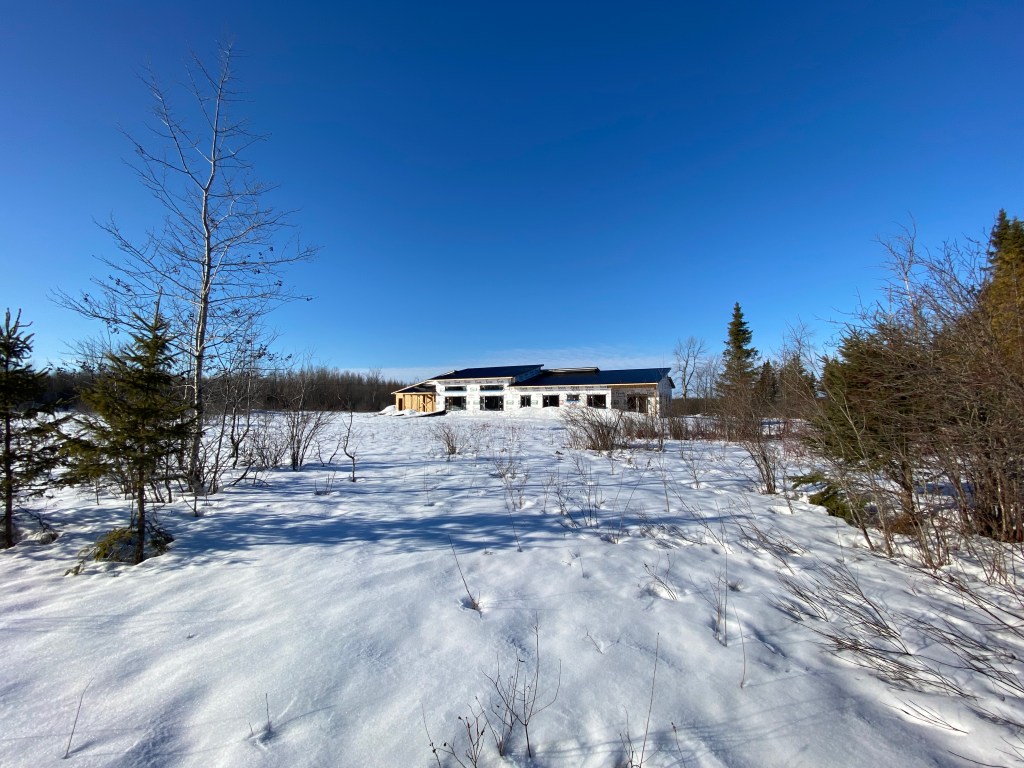
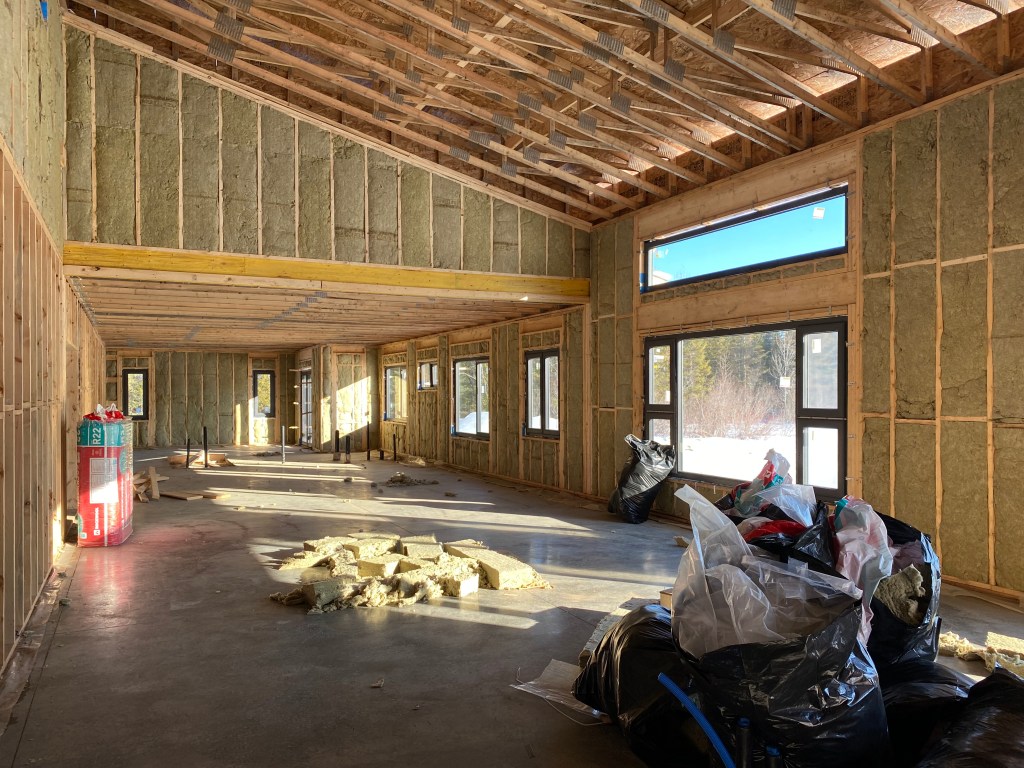


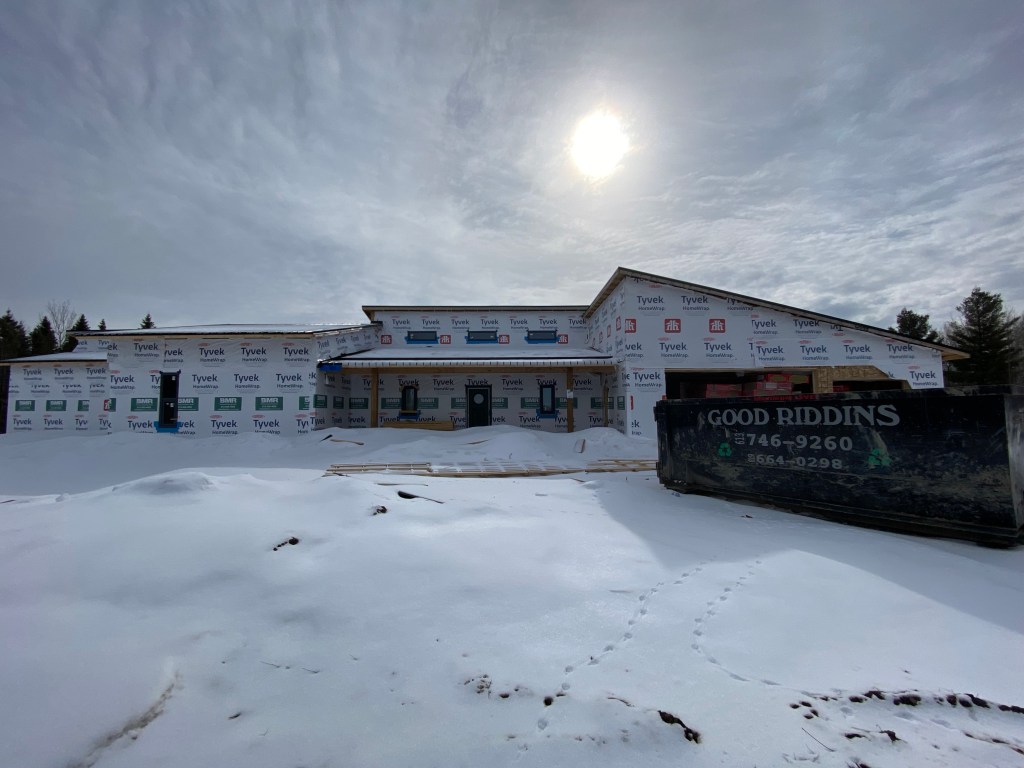

One of the challenges of building a home has been working within the confines of a construction mortgage. This became evident from the get-go with a number of hurdles to overcome.
First hurdle was the reluctance of banks to offer this type of loan. Early in the project, we called around to a few different banks, often getting different information, depending on who we talked to and coming away with the sense that most lenders didn’t offer construction mortgages at all. At one point, we considered going with a private lender. Despite the higher interest rate, this would have provided a good deal of flexibility, which comes in handy with a big project. In the end, after enough calls, we got through to the right people at two big banks. Bank one wanted quotes from every subtrade as part of the application, a task that proved nearly impossible. Bank two had a more straightforward process, similar to a conventional mortgage application – demonstrate income, show proof of down payment, show project cost estimate. Needless to say, we went with bank two, where we were also lucky to lock in a low interest rate that will carry over after we convert the construction loan to a conventional mortgage when the house is done.
Next hurdle, one that we’re currently puzzling out, is navigating the structure of the construction loan. With the loan, the bank releases money in stages, corresponding to the assessed value of the property at different milestones. This unfortunately does not always correspond with the cost of different line items. Compounding the problem is that a few assumptions go into the assessment, such as a) that it is a conventional build (i.e., less value ascribed to things like building envelope) and b) that it is on a serviced city lot (i.e., no expensive septic system or well to install). The assessor is independent of the bank and works off a standard template. They tend to make assessments based on what they know and are familiar with. What this means for us is that we have to carefully plan out how to meet each milestone, and work to help the assessor understand our project. And so, we’re plotting and talking, and progressing bit by bit.
On a sidebar note, another little challenge to keep life interesting comes to us from Hydro Ottawa, who hired a contractor to dig a hole for a new hydro pole. Said contractor deposited all the dirt from said hole into the ditch, completely burying our culvert and blocking the ditch with the spring melt just around the corner.
Our tips for finding a construction mortgage
- Be organized, you’ll need to be ready for or in the process of applying for permits. The bank will want your final design and costed build estimate, along with proof of down payment, proof of land ownership, assessed value of the land, proof of income and assets. Some banks may also ask for quotes from sub-trades.
- Start local. We had better luck calling up local banks than going through online forms.
- Be persistent. Sometimes you just need to find the right person who is familiar with the process to get the information you need.
 Marlborough Forest House