We Found Land!

In an effort to leave every stone unturned, we searched for available land in every way we could. One day, as I randomly browsed listings, I peeked at the real estate section of Kijiji and saw a post for 17 acres in Ottawa with a couple blurry pictures and sparse description near our price range. I was sure it must be a scam, but my partner, self-proclaimed Kijiji King, thought we should give it a go, so we reached out to the seller to ask whether we could take a look.

As it turns out, it was a gem – a wooded lot on a quiet road backing onto the Marlborough Forest, an 8,000+ hectare tract of conservation lands. The couple selling it had used it as recreational property with plans to sever a lot before discovering that wasn’t allowed under the City’s Official Plan.

The sellers invited us to their home and shared a trove of documents, including surveys and a septic permit approval for a house that never got built. We walked the property and found untouched forest surrounding an old pasture with good southern exposure. It even had a little skating pond and a treehouse (well, a shallow pond and a hunting blind but we’re dreamers!). It seemed perfect. Still, we hemmed and hawed, burned from our past letdowns and not trusting that there wasn’t some sort of catch. 

We went back several times as we pondered and spoke to a neighbour who had just sold his home and was moving away. His verdict: very peaceful area but he didn’t like the little snakes and frogs. With a deep breath, we decided to take the leap. We made a verbal offer under asking, which the couple accepted with a handshake deal.

One of the little snakes that drove the neighbours away.

Next came some excitement as we drew up our purchase offer and drafted our conditions (namely, that we needed to seek further assurances and take samples if needed to ensure that we could build a house). Of course, in the middle of all this, we were both slammed at work, leaving us scrambling to coordinate with the lawyers and get formal agreements in place during fleeting moments.

Next came more research as we tried to get as close to reassurance that we could build as we could.

As mentioned in my previous post, in Ottawa, the local conservation authority (Rideau Valley Conservation Authority or RVCA) is responsible for septic permit approvals. It’s important that septic systems not interfere with wetlands and waterways, so there are setbacks that need to be maintained.

There was a small corner of our lot with a river running through it that was designated a provincially significant wetland. We planned to build well back from it and weren’t concerned, but to be sure, we spoke to a development officer from the RVCA and ordered a property file search, which turned up nothing of concern.

Everything was looking good but then things took a dicey turn following several flags from a City development information officer (DIO) which, if true, could have been major impediments to building. This sent me on a deep dive through the Official Plan, the future Official Plan, provincial laws and regulations, and municipal by-laws to fact check what I’d been told. From what I found, the DIO had been wrong on every point. I reached out to the area planner and presented my findings. Happily for us, she agreed and we were back on track. 

Finally, feeling as close to reassured as we thought we would get, we removed our conditions and the land was ours! We toasted our good luck with a glass of cheap sparkling wine in the woods. 

Searching for Land

Finding land to build on is tricky because there are so many unknowns that it takes time and effort to figure out, including:

  • Location (location, location! (and impact on budget))
  • Service availability, such as electricity (and impact on budget)
  • Lot characteristics, such as soil quality (and impact on budget)
  • Appropriateness for our project, such as potential house location and orientation (and impact on budget)
  • Municipal or provincial development constraints, such as protected wetlands (and impact on budget)
Looking for land is no easy feat

Essentially, it’s like navigating without a compass and learning how to sail as you go. It can be hard to gauge what’s insurmountable and what’s not, and whether you’ll be able to afford it in the end.

Our search quickly became our part-time job. We filled our spare time on the hunt and researching everything under the sun. Some of the key resources we used included the following.

Local Conservation Authority

  • Conservation Authorities in Ontario are responsible for watershed management and can provide information on things like location of protected wetlands, floodplains, and natural hazards
  • As we were looking in Ottawa, the Rideau Valley Conservation Authority’s mapping tool was particularly helpful (fun fact, a good portion of Ottawa is swampland)
  • RVCA is responsible for septic system permit approvals in Ottawa and we were able to speak with their planner to determine whether there were any concerns that could prevent a septic permit approval for lots we were looking at. Note: in other municipalities, septic system approvals for rural lots may be done through the municipal building department or the health unit.
  • RVCA also offers a property file search service (for a fee) to identify any previous proposals or reviews related to the property 

Local Municipality (City of Ottawa in our case)

  • In Ottawa, we were able to speak with a planner to confirm zoning and setback information
  • The City of Ottawa has geoOttawa, a mapping tool where you can find a host of property information, including zoning and services
  • Updated floodplain maps are also available on the City website
  • The City’s Official Plan and draft Official Plan were also other important sources information for identifying development constraints and potential future considerations

It’s also a good idea to identify a builder early in the process as we found they were happy to visit properties with us to check for any immediate concerns and sometimes had useful background info to pass along from nearby projects they had worked on. If I can sum up the process that worked for us in seven key steps it would be:

  1. Identify your goal
  2. Figure out approximate budget (budget determines everything really)
  3. Find a potential builder
  4. Look for land
  5. Research the land
  6. Place an offer
  7. Repeat steps 4-6 as necessary

Our Search Begins (Or, Riding the Rollercoaster)

In the beginning, we thought we would buy a house on acreage. Cooped up in a townhouse with a small backyard and little space for projects, we looked around and realized that country homes a few minutes outside the city core cost about the same as a box squeezed into a small lot in the suburbs. We signed up with a realtor and went to look at a few places, placed a few offers, and lost all our bids. In truth, the whole process was an emotional rollercoaster that saw us finding a house, getting our hopes up, and being let down while making more and more compromises and expanding our search criteria each time. 

As I mentioned in my previous post, while navigating the market, we began to toy with the idea of building an eco-friendly passive-style house. While building a new home in the country is not exactly the greenest lifestyle choice, in a car-centric, sprawling city like Ottawa, it certainly had more appeal than a house in the ‘burbs where a car is essential for nearly every trip outside the home. At least in the country we could expand or vegetable gardens, raise chickens, and find our entertainment at home in the woods. If we could do so in a house with a low energy footprint, more the better.

Garden in the city
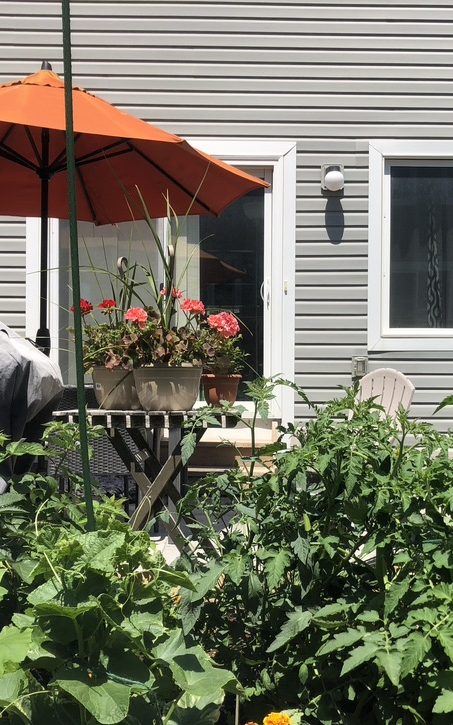
I’m a maximalist when it comes to gardening, leaving little space for much else in our townhouse yard.

We came across Ekobuilt, an Ottawa-area company that sells passive house packages. This company has the admirable goal of making passive homes more affordable. As we explored packages with them, building a house began to look financially viable. We turned our sights to buying land. But, as we soon discovered, if buying a house seemed a tall order, then buying a building lot is a whole new mountain.

Now, I in no way mean to disparage realtors, but I admit to a bit of disillusionment with the process of working with a buyer’s agent. We found that, with access to real estate listing apps like Redfin and HouseSigma, we could find our own listings and check sales data for comparable properties on our own. The realtor was primarily there to present the offer (which we were pretty confident we could do on our own). As we turned our search to land, it became clear that we would be doing lots of leg work either way, so we parted ways and continued our search. What a process that was! More on that to come.