It’s easy enough to indulge in the fun parts of designing a house, but inevitably, practical concerns bring you down to earth. After all, the perfect floorplan doesn’t mean much if you can’t afford to build it. While an architect is an expert at giving form to your ideas, the best person to tell you how much a house will cost is someone with experience buying building materials and hiring trades. You need a contractor.
If you’re building a net-zero passive-style home, you’ve narrowed the field quite a bit to a short list of people with experience building this type of house. We started our search by Googling contractors in our area that advertised net-zero builds and found three or four to interview. This process took some time. Contractors are chatty people, as a rule, and it can take persistence to get from initial talks and hypotheticals to firm answers. Still, we found it helpful to show them what we were working on to figure out whether it was even within the realm of possibility to build within our budget.
We spent several months in a Goldie Locks period of feeling people out. One had good pricing but was moody and combative, another talked a good game but lacked follow through, and one insisted it was impossible to build a house for less than seven figures while trying to scare us away from the competition by professing ominous, but vague concerns for our wellbeing. We eventually settled on one our architect had worked with recently, Kaner Contracting. They were good-natured, organized, and could work with our budget.
A word on terminology, in Ontario, the New Home Warranty Program exists to ensure builders provide warranties on homes they build. In the usual scenario, a builder has control over the project and the subcontractors who build your home and then warranties the work after you take possession. If you’re building your own home, however, you may opt to be an owner-builder, meaning that you retain control over the project and are responsible for hiring subcontractors directly. You may hire a project manager with experience in building to coordinate the project. In this case, you don’t have a builder to warranty the build, though you still have the warranties of each sub-contractor. This is the route we opted to take for greatest control over our project. We also wanted to reserve the option to do some things ourselves where it’s within our abilities. All this to say, though I use contractor or sometimes builder as shorthand, we are our own builder and hired a knowledgeable project manager for our build.
With our project manager hired, it took several more months to get anywhere close to firm costing of our project. It seems that subcontractors don’t like to quote services too far out and, factoring in rapidly changing material prices throughout 2021-2022, a project estimate was a slippery fish to catch. We found ourselves a bit bemused trying to figure out how to keep within budget. All our ideas for keeping building costs down – things like simplified footprint, lower ceilings, less square footage – we’re shrugged away by contractors as saving us a bit but ‘not that much.’ Ultimately, it seems, building a house is a leap of faith. We got as close to a comprehensively quoted project as we could, took a hard look at our finances, our mortgage approval, and worst-case scenarios, and jumped.
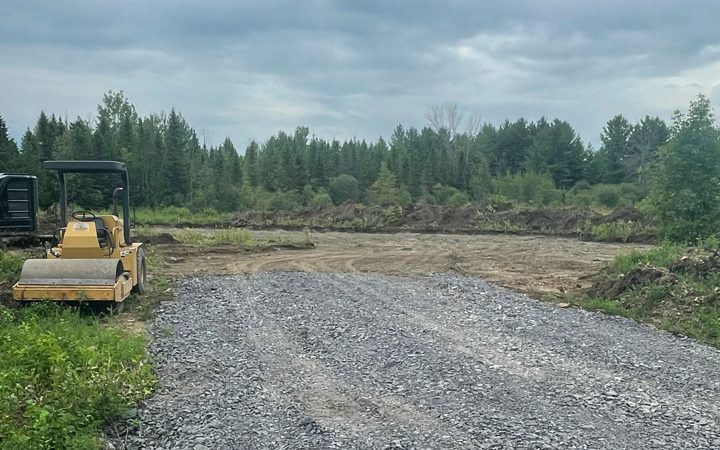
Our project officially kicked off in June 2022 with surveying and installation of our temporary access. We quite like our wide driveway!
 Marlborough Forest House